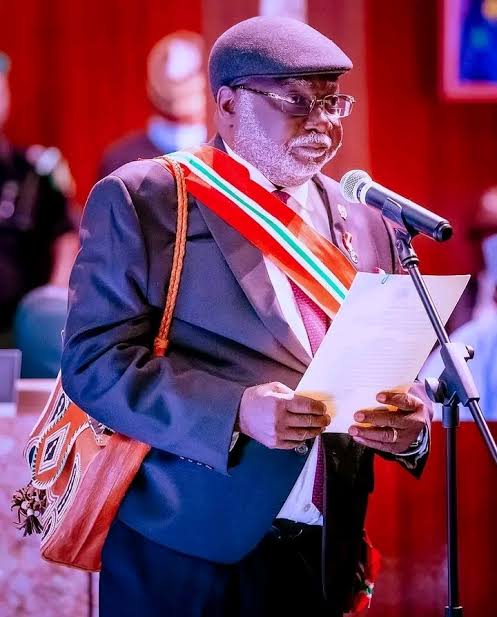
The Judicial responsibilities of the Chief Justice of Nigeria, Olukayode Ariwoola have been scrutinised by some agitated lawyers.
The legal practitioners including the Nigeria Bar Association (NBA) were of the opinion that the CJN controls all entities within the judiciary namely the National Judicial Council and Federal Judicial Service Commission.
According to the NBA, “The inherent flaws in the composition of the NJC impacts negatively on its ability to prosecute judicial misconduct in a manner that inspires public confidence.
Consequently, the NBA recommended that “members of the NJC should be appointed as follows: six judicial officers appointed by CJN; six lawyers nominated by the National Executive Council of the NBA including the NBA President and six non lawyers appointed by the President, Federal Republic of Nigeria, subject to the approval of the Senate.
“The Chairmanship of these bodies should be rotated between the heads of the three constituent groups.”
This proposal for the creation of this office takes cognizance of the role of the Chief Registrars of courts who will under the proposed arrangements enable them (together with heads of courts) concentrate solely on the business of adjudication especially case management without distraction
National Judicial Council is responsible for disciplining judicial officials found wanting in conduct while FJSC is the body that initially reviews proposals or lists of candidates by appointment into judicial office.
During the National Justice Summit 2024 convened by the Attorney General of the Federation and Minister of Justice, Lateef Fagbemi, (SAN), held at the National Judicial Institute in Abuja, resolutions to present the ongoing constitution review process to the National Assembly for inclusion was concluded.
A senior advocate of Nigeria, Dr Babatunde Ajibade who’s the Chairman of the Joint Planning Committee of the summit, said the summit came out with some far-reaching measures on the nation’s justice reform.
“There was a concern expressed about the fact that the Chief Justice of Nigeria, who is the chairman of the NJC is also the Chairman of the Federal Judicial Service Commission, which is the body that initially reviews proposals or lists of candidates by appointment into judicial office.
“The members (of the panel) pointed out the seeming inconsistency between the Chief Justice of Nigeria playing both those roles, as it would appear that he was then recommending candidates to himself, being chairman of both bodies and being the person who appoints a significant number of the members of both bodies other than those who are statutory members.
He stressed on the need to reduce the number of cases that make it to the Supreme Court to reduce the workload of the court.
In Nigeria, apart from state legislative and National Assembly election petitions which terminate at the Court of Appeal, other matters such as burglary, theft, and more are finalised at the Supreme Court.
“There is the importance of limiting the jurisdiction of the Supreme Court, and ensuring that matters that would go to the Supreme Court would only be matters of significant national importance.
The guidelines of the NJC allows the State Judicial Service Commissions to make judicial appointments, because the NJC guidelines, rather than authorising the State Judicial Service Commissions to prepare a shortlist of potential candidates for judicial appointments, appear to address that responsibility solely in the chairman.
Recall in 2023, a retired supreme Court judge, Dattijo Muhammed, criticised Justice Ariwoola for enjoying too much oversight and administrative powers across the nation’s judiciary.
In a similar trend, the Body of Benchers also set up a high-powered committee headed by a former Chief Justice of Nigeria (CJN), Justice Walter Onnoghen, to look into the spate of conflicting court judgments in the country, and other related problems that affect the courts.